

With the news of a General Election on 4 July breaking last week, dentists around the UK are now wondering what this could mean for the dental industry and dental businesses.
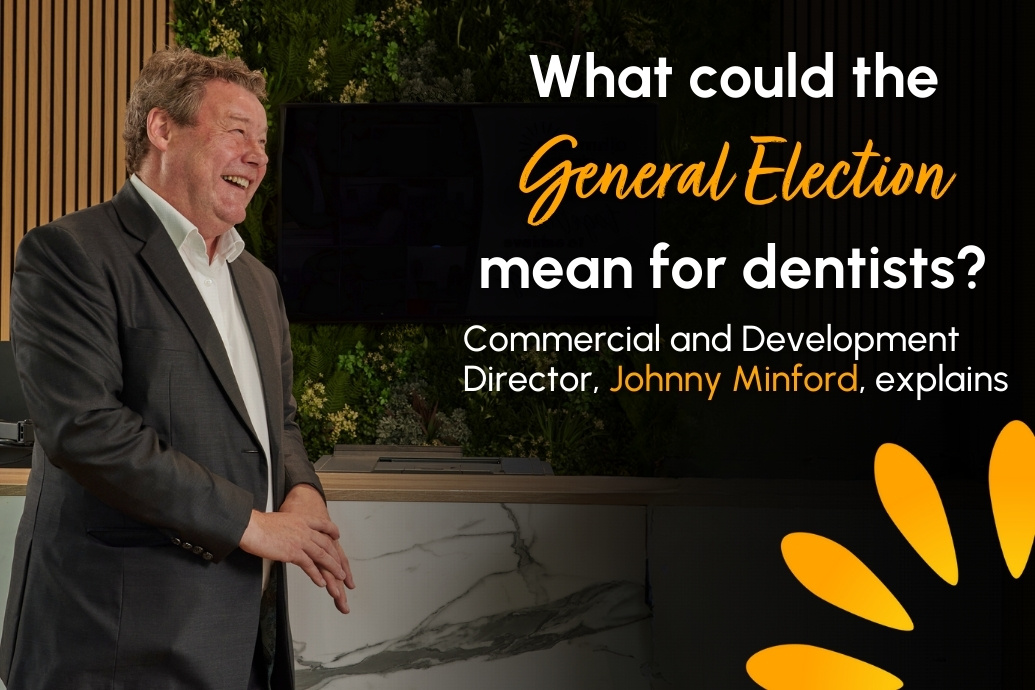
We’ve asked Johnny Minford, Commercial and Development Director, to outline what a change in government, either to Labour or a refreshed Conservative parliament could mean for dentists.
Take it away Johnny
A new government could have significant impacts on the dental industry. Policies regarding healthcare funding, NHS contracts, and private practice regulations are often influenced by the ruling party’s priorities and while the exact outcomes are uncertain, it’s clear that the Election outcome could bring both challenges and opportunities for dentists across the UK.
Below I’ve outlined the implications a General Election could have for dentists.
Tax
Corporation Tax
If Labour gains power, they plan to maintain Corporation Tax at the current rate of 25%. This was increased by the current government from 19%, and is therefore unlikely to reduce any time soon, irrespective of who is in power on 5 July. Within their first six months, Labour intends to outline a future business taxation strategy.
Equally, the Conservatives aim to support businesses by keeping taxes low, but a low tax environment is only achievable if the economy keeps growing. The positive news is that Corporation Tax is unlikely to increase this year, regardless of the election outcome.
Income Tax
Post-election, the Conservatives stated plan is to avoid raising income tax and aim to cut it. Labour has equally said that it will not raise the income tax rates. However, they have in the past talked of taking the lowest paid out of the taxation net; we might see an increase in the personal allowance and reduction in employee NIC rates to facilitate that. Might this be balanced by an increase in employer NIC and a freeze on thresholds at higher levels? Certainly, the point at which the highest rates of tax are introduced may be examined.
Both parties may commit to not increasing the income tax rates, but Labour are so far vague on capital taxes such as Capital Gains Tax. This remains a concern for practice owners approaching retirement, and of course a consequent effect on the practice sale/purchase market.
The Conservatives have stated that they do not plan to raise national insurance if re-elected, and The Chancellor, Jeremy Hunt, recently suggested his longer term aim was to abolish it. There is yet no Labour comment on this. Dentists working through a limited company, replacing self-employed earnings with dividends, will likely be affected, perhaps indirectly, and we will need to keep a close watch on such developments.
Universal Basic Income
Another idea that has been around on and off is that of a universal basic income, which might replace the personal allowance and be withdrawn via the tax system for those on higher incomes.
Pension relief
Relief for pension payments will undoubtedly be scrutinised after the Election, whoever wins. This will be especially relevant to dentists under the NHS Schemes, who are more limited in how they can react, and who see their superannuation as a positive aspect of their commitment to the NHS. We await comment.
Tackling Tax Avoidance and Evasion
If the General Election brings a Labour majority, we could see major changes in cracking down on tax avoidance and evasion. This could lead to a rise in penalties.
Labour have suggested a harsher stance of “tax dodgers” with up to £555M additional funding to HMRC; representing an additional 5,000 staff and investment in infrastructure and non-domiciled taxation.
Business Rates
Labour plans significant changes to business rates if elected, aiming to replace the current system with “one suited for the 21st century.” This change is part of their strategy to support small businesses, especially those with physical premises.
The Conservatives intend to review and reduce business rates, starting with retail. They also plan to extend discounts to other sectors, but no comment has been made for Healthcare businesses, although NHS dentists already get a rebate for their rates.
Employment regulations and Dental Practices
The Labour party has committed to enhancing worker protections by banning zero-hours contracts, ending fire-and-rehire practices, and eliminating qualifying periods for basic rights. This means abolishing the requirement of two years of continuous service before an employee is eligible for statutory redundancy pay and protection against unfair dismissal. Additionally, they plan to remove the 26-week qualifying period for parental leave and establish a single worker status for everyone except the genuinely self-employed.
Minimum wage and employment costs
The increases in minimum wage in recent years have a knock-on effect on everyone working in a business, as those above the minimum wage are pushed to maintain the status quo. Further increases in this, or in National Insurance rates will directly hit practice profits, and whilst private practices have the capability to increase their prices to their patients, NHS practices have their incomes fixed. It will be interesting to see how this may be taken into consideration by a new Department of Health team who have a stated goal to extend NHS dentistry access.
With many dental practices struggling to recruit and retain staff, consequent amendments to the labour laws and taxation of employees will be examined very closely in the event of a Labour win.
NHS Dentistry
There have been changes over the past two years to NHS Dentistry. Labour have been vocal in their commitment to further positive change to patient/public access. Such change does not of course just affect the NHS practices, but ripples are felt across the whole market. It will be interesting if any practical suggestions for NHS dentistry are made during the Election campaign itself, but we certainly wait with bated breath the proposals from the new Secretary of State for Health should Labour win on 4 July.
We will wait to see the results of the election in just over a month’s time and will keep you updated with any changes once they have been announced.