



R&D Tax Reliefs: what they are and how much are they worth?
R&D Tax Reliefs encourage businesses to innovate, providing upwards of 15% of Corporation Tax relief for every £1 spent investing in innovation. You can find each scheme and the net relief available, below:
RDEC (Merged)
- Profitable companies – 15% (i.e. £15,000 for every £100,000 spent on qualifying R&D activity).
- Loss-making and small profit-making companies – Up to 16.2%.
Enhanced R&D Intensive Support (ERIS)
- Loss-making R&D-intensive SME companies – Up to 26.7%.
This benefit can either reduce your Corporation Tax liability, generate a refund of tax that you’ve already paid, or if you have tax losses, you can claim a cash credit.

Who can claim R&D Tax Reliefs?
If your company has worked to develop new or improved technological or scientific solutions, it may be eligible for R&D Tax Reliefs.
Specifically, a UK limited company must have been working on a project (or projects) that ‘advance existing science or technology’. They must also be able to demonstrate that this work wasn’t easily deducible by other competent professionals working in their field.
We’ve made successful claims across a range of sectors, including:
-

Engineering
-

Manufacturing
-

Software and IT
-

Pharma and scientific
Q. What qualifies for R&D Tax Reliefs?
A. Development of new or improved…
-

Products
-

Processes
-

Software
What costs qualify for R&D Tax Reliefs?
 Staffing costs (including Externally Provided Workers)
 Subcontractors
Software
Subcontractors
Software
 Cloud computing & data licensing costs
 Materials
 Utilities
Our process for R&D Claims
-
1. Scoping / Initial Discussion
Firstly, we’ll work with you and your technical team to review the development work carried out by your company to determine which areas would qualify for R&D Tax Reliefs (assessed against HMRC’s prevailing guidance).

-
2. Produce Claim
We’ll then support you to produce the technical narrative, costs summary and compliance information (including HMRC’s Claim Notification form) required for every claim.
We’ll also discuss the options for best utilising the Corporation Tax benefit of the claim.
-
3. Submit
Then we’ll take care of the submission of the claim to HMRC via the company’s Corporation Tax return and CT600 (plus HMRC’s Additional Information form).
Our R&D insights
-
 25 June 2025
R&D Tax Reliefs for Innovative Software Development Businesses
If you’re running a software or technology business, you’re likely at the cutting edge of innovation in the UK. Whether you’re developing groundbreaking software platforms, engineering sophisticated system architectures, or investing in experimental AI development, you’re part... -
 3 June 2025
Does your business own or license any patents?
Patent Box is a UK incentive that allows companies to reduce their Corporation Tax liability on profits earned from patented inventions. The relief is designed to encourage companies to invest in R&D and protect their intellectual property through patents. We’ve asked our R&D Incentives Director,... -
 14 April 2025
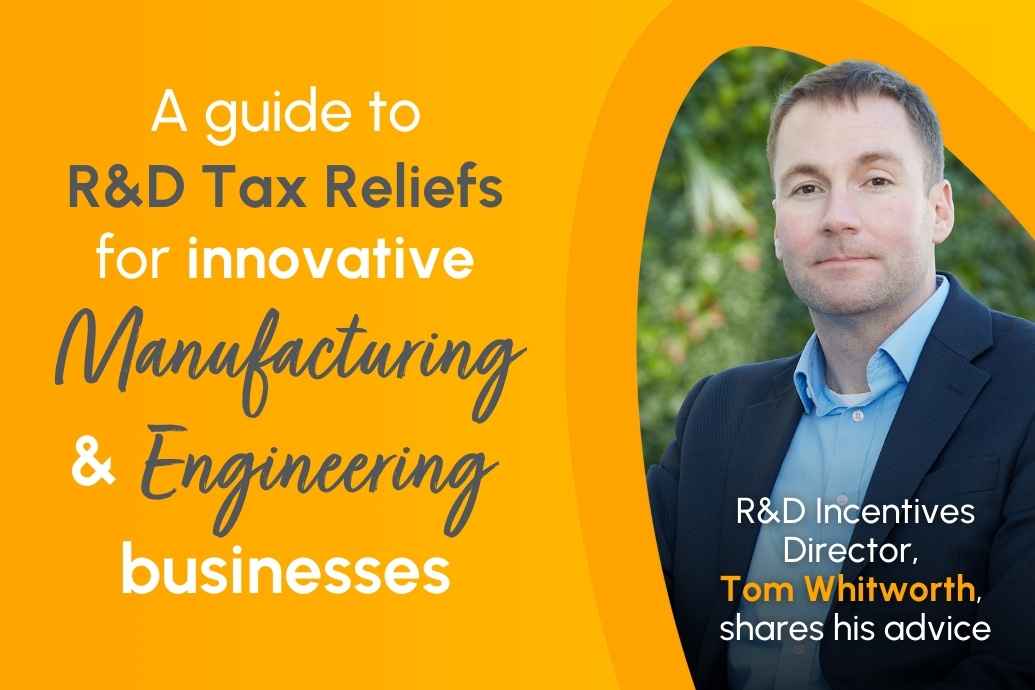
R&D Tax Reliefs for Innovative Manufacturers and Engineering Businesses
Operating in highly competitive markets, the manufacturing and engineering sectors have long been at the forefront of innovation in the UK. Staying ahead in these industries often requires developing advanced processes, innovative products and specialised tooling. However, these critical developments...
Other R&D Services


Patent Box
Latest news and insights
-
 19 January 2026
Freed to Focus on Football: How Christian Nørgaard Built Confidence in His UK Financial Future
A new league, a new country, a mountain of paperwork When Christian Nørgaard arrived in the UK in 2019, he was at a pivotal moment in his career. The Danish international, who now has 39 caps for his country, had built a strong reputation playing in Italy, before joining Brentford FC with high expectations.... -
 16 January 2026
Inheritance Tax Planning after the latest relief changes
December brought a major shift in inheritance tax planning. From April 2026, the first £2.5 million of qualifying business and agricultural assets will receive full relief—up from the £1 million originally proposed. While this increase is welcome, it doesn’t remove the need for careful planning.... -
 14 January 2026
Employment Rights Act: What UK businesses need to know in 2026
The Employment Rights Bill has now passed through Parliament and received Royal Assent, becoming the Employment Rights Act 2025. This landmark legislation represents the most significant overhaul of workplace rights in a decade, with phased implementation starting in April 2026 and continuing into 2027....
Let’s do great things together
Book a meeting to talk with our expert team by clicking the button below.