



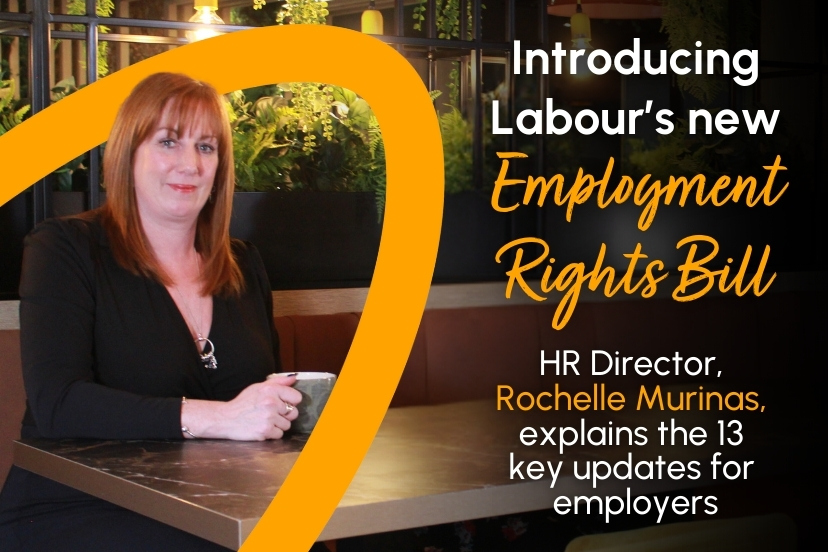
After a long-anticipated wait, the Employment Rights Bill was finally announced on Thursday, October 10. This bill sets the stage for significant changes to UK employment law, which means a lot to unpack and understand for UK businesses.
The good news is that our partners at Innov8 Human Resources have reviewed the 158-page document since its release, and Rochelle Murinas, DJH HR Director and Managing Director of Innov8 Human Resources, has provided us with a breakdown of the key changes and what they could mean for your business.
Over to Rochelle:
While many details are yet to be confirmed, there doesn’t seem to be as many answers as I expected, but it’s clear that significant changes are on the horizon.
Current media speculation suggests an October 2026 implementation, but at this moment in time, this remains unconfirmed by the Government. Some initiatives may even carry over beyond the next election, and notably, several manifesto promises are absent from the bill.
Key updates for UK Businesses
- Unfair Dismissal/Day 1 Right – The 2-year qualifying period to bring a claim for unfair dismissal has been withdrawn (as long as the employee started work, the offer wasn’t withdrawn and a few other exceptions), affecting an estimated 9 million employees across the UK. This will emphasise the need for robust recruitment processes as an employer will no longer be able to terminate someone’s employment in the first two years without a fair reason for the dismissal, or a documented process during a probation period. Further consultations on the probation periods are expected, with rumours suggesting a cap of 6 – 9 months.
- Statutory Sick Pay (SSP) – This will now be payable from day 1, potentially increasing short-term absences. This is a big financial burden for SME’s, as they’re unable to claim SSP back from HMRC. The lower earnings threshold for SSP will be adjusted, with a % of pay rule introduced.
- Zero Hours – This is a little more complicated. There will be a guaranteed hours provision, which is a right to reasonable notice and payment for shifts cancelled at short notice. This also applies to those who have minimum-hour contracts. Further details are needed on the reference periods, however, in addition, compensation could be payable to employees bringing a claim against their employers for failing to comply with the provision. However, the thresholds are currently unknown.
- Flexible Working – Minor changes focus mainly on the reasons for rejection, with a need to give clearer reasons for refusal, with compensation of 8 weeks pay for breaches. Apart from this, there are no further major changes from what I can see.
- Fire and Re-hire – It will be automatically unfair to dismiss an employee for refusing a contract variation. There is a very limited exception to this, which is that if a business shows they’re seriously threatened by closure due to financial issues, as long as they’ve undertaken a lot of consultation first before enforcing this, they can fire and rehire to essentially prevent the total collapse of the business.This is a big risk for larger organisations, but potentially easier to justify this exception in a smaller business!
- Harassment – an employer will have a duty on to take all reasonable steps to prevent third-party harassment. This is a shift back to the early days of when the Equality Act was established.
- Sexual Harassment – This will be protected under Whistleblowing legislation in the future, increasing employer responsibilities and risk. This could create a 25% uplift in costs at an employment tribunal which will be enforced by a new government body. We will be running training courses to provide clear policies, clear risk assessments and a process for reporting and handling complaints.
- Redundancy – Collective consultation obligations will apply where there are more than 20 employees affected. This will mean the whole business must be consulted, and not just one site. It means that when deciding whether there are 20 or more proposed redundancies, the number of redundancies across the whole business should be totted up, and separate sites should be treated as one.
- Gender Pay Gap/ Menopause – Businesses with 250+ employees may need to produce equality action plans and support menopausal employees.
- Statement of Particular / Contracts – Once the bill comes into force, written statements must have an extract setting out the right to join a trade union.
- Enhanced protection for pregnancy and new mothers – Currently there is minimal specific protection for new mothers. The Bill contains proposals to strengthen protections for pregnant employees and mothers returning to work. Timescales for new mother protection are not yet set out, we’ll need to await consultation for more detail, but many expect this to be for six months after a return to work.
- Bereavement Leave – A statutory right will be introduced for a period for anyone who is bereaved, although the detail of the relationship isn’t specified. It remains at two weeks for parental bereavement leave. Most businesses already do this as good practice, but this is set to become law.
- Enforcement Agency – A newly created government body will pursue employers that behave badly and fail to comply with employment legislation. This is to prevent the shoot from the hip practices, such as P&O Ferries issues.
As I mentioned earlier, from what I can see, there is quite a bit missing from what was pledged form the Labour Manifesto. This includes:
- A right to switch off.
- A requirement to report on ethnicity and disability pay gaps for large employers.
- A single status of worker or transition to a simpler two-part employment status.
I suspect that some of this will come, but as they’re not quick wins, potentially they may come further down the line. They may roll over to the next government, who knows?
I will keep you updated with further things I come across in the coming weeks.
Join us our Budget Unwrapped Events
DJH and Innov8 Human Resources have teamed up to host a series of events in Leeds, Manchester and Stoke on the 5th, 6th and 7th November, where Rochelle will discuss the Employment Rights Bill in much more detail, along with updates on any tax reforms announced in the Autumn Budget on 30th October.
Click here to find out more about these events.