



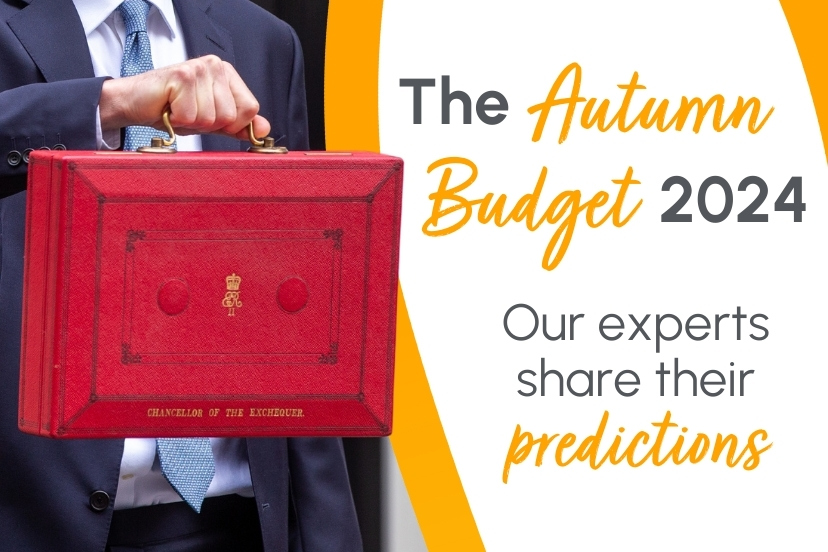
We’re now only a week away from The Autumn Budget, following an intense period of speculation on what The Chancellor, Rachel Reeves, first budget will look like.
It’s been reported that the Chancellor is drawing up plans to fill a £44bn funding gap, up from the original estimation of a £22bn blackhole. This has only fuelled this speculation about what this will mean for you, your business, and your future.
We asked our experts to sort through the rumour-mill and pick out what they believe could be introduced as part of next Wednesday’s announcement. Before we dive in, it’s worth mentioning, that if or when any changes are announced, planning is key to ensure you’re in the best shape possible.
Pensions: Preparing for reform
First up with their predictions on pensions is George Lovell, Director at DTE who suggests that a cap could be introduced on the tax-free lump sum that can be withdrawn from a pension. He believes that a tax-free withdrawal will remain at 25%, but an overall cap introduced. If this cap was, say £75k, this would leave the majority of people unchanged, impacting those with pension funds above £300k.
Michael Burgess, Tax Director, agrees with George that there may be change to the lump-sum but also adds that tax relief on contributions could be restricted to 20%, affecting both higher and additional rate taxpayers.
On the state pension, Michael believes that this is the time they may look to increase the state pension age. He believes this is highly controversial but could be something that could be implemented to increase the years people need to contribute to it.
Josh Draycott, Tax Manager, and Jack Farmer, Chartered Financial Planner at our partner Wealth Experts, delved into all the potential changes and highlighted what they believe might be on the horizon, in their recent article, which included:
- Tax Relief Adjustments
- Tax-Free Cash Limitations
- Death Benefit Taxation
You can read their full thoughts on the above in their article – Rumoured changes to Pensions in the upcoming Autumn Budget 2024
Inheritance Tax (IHT): Closing the loopholes
Matt Verling, Tax Manager, senses a few changes on the horizon but feels there are two main areas where an increase is likely. Firstly, the effective rate trusts pay on 10-year charges could see an increase to 8-9%. Secondly, he feels that the new government will limit Business Property Relief (BPR) to 50% on any shares which are not those of a person’s own personal company.
For Lewis Rutherford, Tax Senior, believes the Nil Rate Band, Residence Nil Rate Band and Business and Agricultural Relief, may be restricted or harder to access, by reforming the criteria. He also thinks that progressive IHT rates could be introduced for larger estates.
Shannon Steele, Tax Manager, points to the fact that Labour has already hinted at a comprehensive review of IHT to make the system fairer. She recently put together her thoughts on what could be introduced as part of these changes, including private pensions, lifetime giving rules and Capital Gains Tax.
You can read more about Shannon’s IHT predictions here – Inheritance Tax overhaul: Labour’s potential plans explained
Capital Gains Tax (CGT): Changes looking likely
One of the most consistent predictions by our team was the increase in the rates of CGT, with both Brody Evans and Beth Hickman from our tax team believing these will rise.
There has been talk about an increase to CGT which could mirror the additional rate of income tax rate of 45%. Mark Morris, Senior Tax Manager, doubts this figure will be accurate but does believe that there will be an increase as suggested. He believes it’s a fine balance to get the percentage right though, as putting the rates too high would lead to individuals holding onto assets until the rates fall, which could ultimately lead to a reduction in the tax take, rather than an increase.
Paul Darley, Managing Director at our partner Wealth Experts suggests that this CGT rise may be up to 12% (basic) and 22% (higher rate) for the sale of shares, and can foresee 20% (basic) and 30% (higher) on the sale of second properties.
Connor Smith, Senior Tax Manager, believes the changes to CGT will be a mixture, or combination of the following:
1. Increasing the standard rates of CGT.
2. Removal of Business Asset Disposal Relief (BADR).
3. Removal of Employee Ownership Trusts (EOTs)
You can read more of Connor’s thoughts, as he delves into the above, in his article – Labour’s Capital Gains changes – How to prepare
VAT on school fees
Our Head of Indirect Tax, Matt Orange, has already spoken to several private schools about the removal of the VAT exemption for educational services and what they need to do to be ready.
He highlights that the change itself has caused confusion and many in the sector are asking for the change to be deferred. In September, the ICAEW even added their support to this delay as it didn’t believe that the 1 January 2025 deadline is enough time for private schools to prepare for the changes.
You can read Matt’s summary of the changes, the concerns and how we can help here in his article – Changes to VAT on private school fees
What else could be announced?
Non-Dom Status: Changes ahead
Shannon Steele has also highlighted the non-dom status which has come under-fire in the past. The current regime allows individuals, who are resident in the UK but non-domiciled, to be exempt from IHT on their non-UK assets. Proposed changes could impact those who haven’t been a non-UK resident for the previous 10 years, potentially exposing their non-UK assets to a large IHT bill.
Commercial property owners: Watch this space
Chris Roberts, Director of Capital Allowances, has suggested that the initial reaction to the announcement that the previous government was to abolish the Capital Allowances available for the Furnished Holiday Lets sector suggests it may not be enforced.
The good news is there has been no suggestion or signs to indicate Full Expensing and the £1m Annual Investment Allowance is to be changed. If Full Expensing remains unchanged, this will be great news for the larger organizations that spend significant capital each year. Full Expensing will play are large part in mitigating tax liabilities especially for those companies that may be exposed to a higher corporation tax rate.
National Insurance: Rising employer contributions
National Insurance (NI) has featured a couple of times in previous budget, being reduced from 12% to 10% in last year’s Autumn Statement, and then down again to 8% in the Spring Budget of 2024. Labour’s manifesto ruled out raising National Insurance but Paul Darley believes that whilst this may be the case for employees, Employer’s NI contributions could be increased on wage or pension contributions.
Need more support?
A budget can always be a time of uncertainty, elevated when a new government is the one with the red briefcase at the dispatch box.
Remember, these are expert predictions rather than confirmed changes, so we’ll be keeping a close eye on the announcement on Wednesday 30 October and will be ready for our early-round up later that day, followed by a detailed report on Thursday 31 October.
We’ll also be hosting our Autumn Budget unwrapped events, where our team of experts and industry leaders will guide you through the changes in the Autumn Budget, in-depth analytics of how they may impact you and your business, as well as strategies to optimise your finances.
You can find out more and book your place by visiting our event pages: