



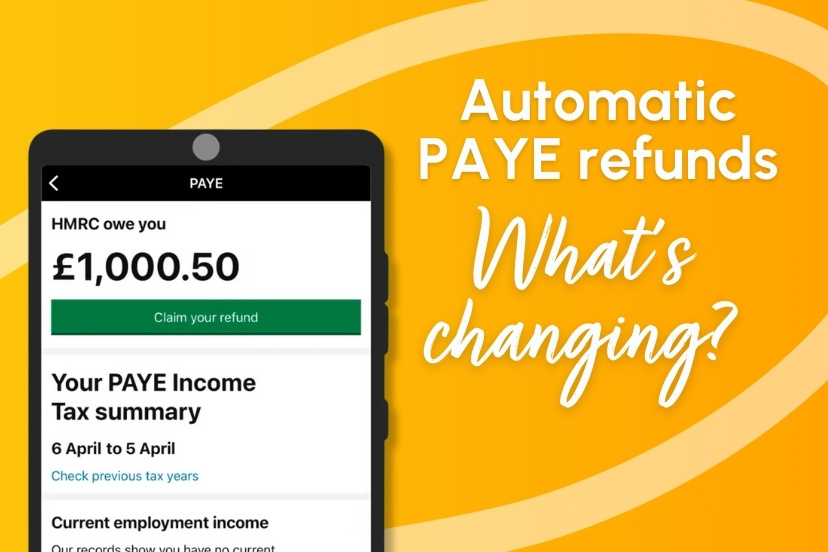
Important changes to automatic PAYE refunds

HMRC have made the decision to stop posting out automatic cheques for individuals who are due tax refunds. Instead, individual employees will now need to register a claim online, to make sure they receive their repayment of PAYE.

The decision has been made to help drive more online usage and reduce any potential fraudulent behaviour.

What does this now mean for you?

Under the old system, all employees who received a tax calculation letter, which is also known as a P800 that includes details about a PAYE overpayment but didn’t claim the repayment online, would normally automatically receive a cheque in the post after 21 days.

Since 31 May, HMRC have stopped issuing cheques automatically, leaving it up to the taxpayer to act to receive payment. P800 letters are sent out between June and the end of November.

Cheques can still be available if they are requested, but it can take up to 42 days or six weeks for a cheque refund to be issued.

HMRC have stated that in the future, customers will receive instructions on their P800 letter, explaining how to claim a repayment.

Repayments will then be made by HMRC using the online bank transfer service, which can take up to five working days.

HMRC has highlighted that there will still be non-digital routes for taxpayers who are unable to use online services to make sure they can claim their repayments.

Alternative claim methods

Whilst online claims are the most encouraged method, there are other options available to receive your PAYE refund. This includes:

  • Through your personal tax account
  • Using the HMRC app
  • Contacting HMRC directly

Here to help

If you have any questions about PAYE automatic refunds, or are looking for tax advice, we’re here to help. Simply fill out the form below and one of our team will be in touch.

    Your information will be used for the purpose of sending email newsletters by DJH Holding Group Limited and its subsidiaries – a full list of which can be found on the Company Information page of our website. You can opt-out of our marketing communication at any time by clicking the unsubscribe link or emailing [email protected] with the subject line ‘Unsubscribe’.

    You can find out more about how we use your data by reading our Privacy Policy

    Latest news and articles

    • Uk tax advice for footballers
      19 January 2026

      Freed to Focus on Football: How Christian Nørgaard Built Confidence in His UK Financial Future

      A new league, a new country, a mountain of paperwork When Christian Nørgaard arrived in the UK in 2019, he was at a pivotal moment in his career. The Danish international, who now has 39 caps for his country, had built a strong reputation playing in Italy, before joining Brentford FC with high expectations....
    • Inheritance tax planning
      16 January 2026

      Inheritance Tax Planning after the latest relief changes

      December brought a major shift in inheritance tax planning. From April 2026, the first £2.5 million of qualifying business and agricultural assets will receive full relief—up from the £1 million originally proposed. While this increase is welcome, it doesn’t remove the need for careful planning....
    • Employment Rights Act 2025
      14 January 2026

      Employment Rights Act: What UK businesses need to know in 2026

      The Employment Rights Bill has now passed through Parliament and received Royal Assent, becoming the Employment Rights Act 2025. This landmark legislation represents the most significant overhaul of workplace rights in a decade, with phased implementation starting in April 2026 and continuing into 2027....

    Proud to work with: