



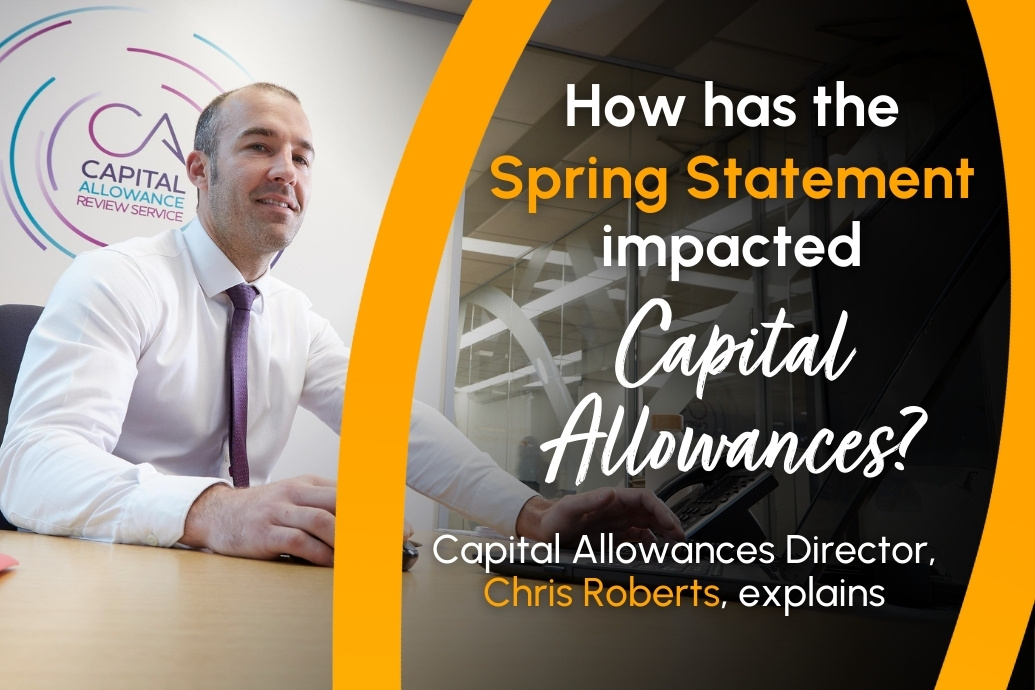
As the aftermath of the Spring Budget 2024 settles in, businesses are urged to take immediate action to navigate the significant changes in capital allowances.
Jeremy Hunt’s announcement on March 6th, 2024, has sent ripples across sectors, necessitating swift adaptation to the altered fiscal landscape.
Among the key revelations is the abolition of the Furnished Holiday (FHL) tax regime, effective from April 6th, 2025. This policy shift aims to bolster local residency by equalising tax treatments between short and long-term lets. Consequently, properties qualifying as FHLs will lose entitlements to capital allowances, profoundly impacting property investors.
Chris Roberts, Capital Allowances Director, has explained the changes in more detail and whether the changes implemented are positive or not.
Take it away Chris
The announcement to abolish the FHL regime will certainly impact many property investors and require urgent attention to rethink their options and business plans. The transition from super-deduction to Full Expensing (FE) has also garnered attention, as well as extensions to Freeport tax reliefs underscore the government’s commitment to incentivise investment in designated zones.
Below I’ve explained the key changes in more detail, starting with Furnished Holiday Lets…
Furnished Holiday Lets
From 6 April 2025, the Furnished Holiday Regime will be abolished. The Chancellor announced a new policy which is aimed at supporting people who live locally. This policy will be carried out by treating short-term and long-term lets the same way for tax purposes.
FHL and non-FHL properties will now no longer need to calculate and report income separately.
Currently, if you let properties that qualify as FHLs, you’re entitled to plant and machinery capital allowances for items such as:
- Furniture.
- Equipment.
- Fixtures.
This along with the other benefits included in the regime will cease from 6th April 2025.
Full Expensing (FE)
Full Expensing replaced the super-deduction and was announced in the Budget 12 months ago, coming into effect on 1 April 2023. This scheme is available only to companies, allowing them to claim 100% of the cost of qualifying main/general pool expenditures against their profits. Like the Annual Investment Allowance (AIA) but without an upper limit, it lets companies fully deduct these costs in their tax returns for the financial period in which the expenditure occurs.
Eligible expenditures for the main pool include items like:
- Vans.
- Lorries.
- Laptops.
- IT equipment.
- Sanitary ware.
- Office furniture, such as desks and chairs.
Special Rate pool qualifying expenditures, however, are subject to a 50% First Year Allowance.
For companies paying the new tax rate of 25%, Full Expensing results in savings of 25p for every £1 spent. For companies with profits under £50,000, the savings are 19p per £1 spent.
The Autumn Statement of 2023 announced that Full Expensing would become a permanent allowance. Following the latest Spring Budget, the Chancellor proposed extending Full Expensing to assets for leasing. Draft legislation for this extension will be published shortly, with implementation planned when fiscal conditions permit.
Freeport tax reliefs
Enhanced structures and building allowances are currently available for firms constructing or renovating non-residential structures and buildings within a Freeport tax site. This allowance, which is an enhanced version of the standard structures and buildings allowance, offers a higher relief rate of 10%, compared to the national rate of 3%.
Additionally, capital allowances are available for companies investing in qualifying new plant and machinery assets, with a 100% enhanced capital allowance for such equipment primarily used in a Freeport tax site.
The Spring Budget has updated these reliefs, extending the anticipated end date from five to ten years: until September 2031 in England and September 2034 in Scotland and Wales.
My thoughts
The announcement to abolish the FHL regime will certainly impact many property investors and require urgent attention to rethink their plans. Although we have observed varying interpretations of legislation across the sector, we have been involved in preparing claims for speculative FHLs with the incentives from Capital Allowances encouraging the investment.
The recent abolishment will no doubt have an impact on future FHL projects, which will be a pity. We eagerly wait to hear how this impacts existing Capital Allowances pools.
Full Expensing is having a positive impact, so it is good to see this broadened to the assets for leasing.
Here to help
If the changes to capital allowances have you wondering if you’re able to reduce your tax liabilities, we’re here to help. To speak to one of our experts, please fill out the form below and we’ll be in touch.