



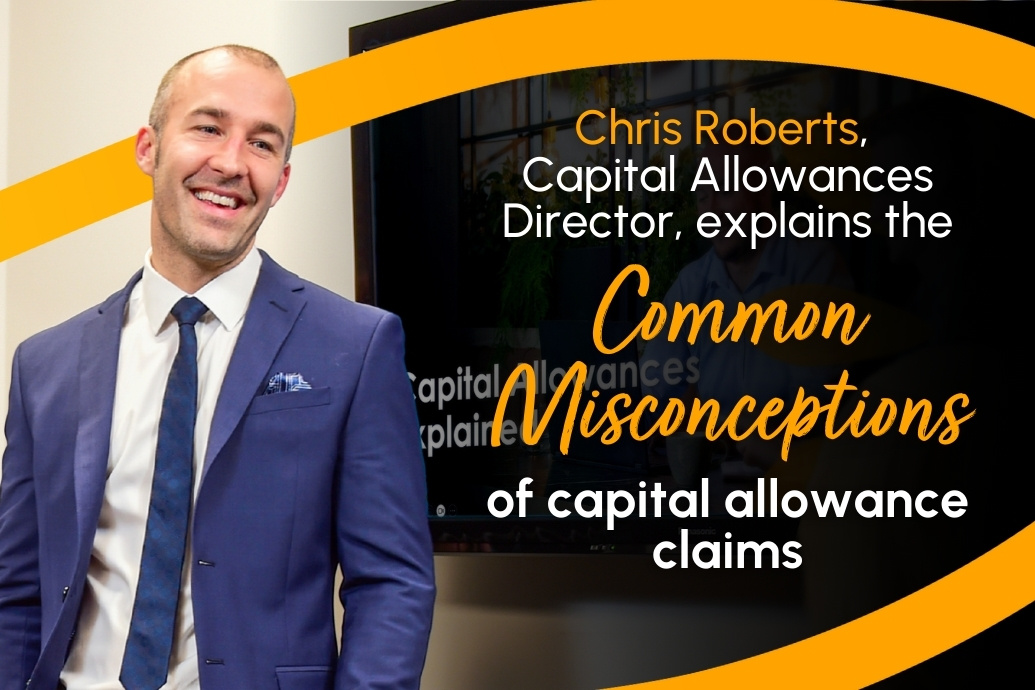
A rewarding and often frequent response when speaking to clients after reviewing their potential capital allowance claim is “I didn’t know I could claim for that!”
It’s not surprising as capital allowances themselves can be tricky to understand. It’s not just what can be claimed either, the allowances, timeframes, and ownership all play a role in adding to the confusion.
As a result of the misconceptions, many commercial property owners are missing out on the valuable tax benefits they provide!
In fact, I started writing these down a few months ago and decided it would make a perfect article to help clear up some of the more common misunderstandings!
“I’ve run out of time to make a claim.”
Here’s something interesting: if you bought your property before April 2014, there’s actually no time limit on making a retrospective claim. For properties bought after April 2014, while there is a two-year window from completion for certain aspects, you can still claim for improvements and refurbishments without time restrictions. So don’t write off your claim chances just because some time has passed.
“But what about my Capital Gains Tax (CGT)?”
We hear this concern a lot – people worry that claiming capital allowances will come back to bite them when they sell. Good news – it won’t! The law (specifically, section 41(1) of the TCGA 1992) is crystal clear on this. Your capital allowances claims won’t increase your capital gains tax bill when you sell. Even better, they won’t affect your property’s balance sheet value either. And here’s a bonus – it won’t impact any Capital Gains Indexation Allowance you might be eligible for.
“They were here when I bought the property, so they aren’t mine to claim.”
Here’s a surprising fact: when you buy a commercial property you’ve also bought everything in it and you might be able to claim capital allowances on the fixtures and fittings that are already there. But timing is crucial – these items need to be identified and valued correctly when you buy, or you could lose the opportunity forever.
“My business is too small for a claim to be worthwhile.”
If you’re running a smaller business, you might actually have more to gain than the big companies. The Annual Investment Allowance (AIA) lets you deduct the full value of qualifying plant and machinery up to £1 million. That could make a huge difference to your tax bill in the year you make the investment.
“I’d love to claim, but I don’t know where my invoices are.”
A surprise for many – you don’t always need original invoices to make a claim. While documentation is helpful, specialists can use other methods to verify expenditures that satisfy HMRC’s requirements. It’s about knowing what evidence works and how to present it properly.
“It all changed years ago, didn’t it?”
The 2014 legislation changes caused quite a stir, and yes, things did change – but capital allowances definitely didn’t disappear! In fact, we’ve seen new opportunities emerge with the introduction of Structures & Buildings Allowances (SBA) and other recent changes. The key is staying up to date with these developments.
“I don’t own any Plant & Machinery… whatever that means”?
‘Plant & Machinery’ isn’t actually defined in law, which helps to fuel the confusion about what qualifies. Obvious embedded elements that aren’t immediately visible in person or on paperwork can be missed. That’s where specialist knowledge comes in handy – experts like us can typically identify more qualifying items than the untrained eye.
You can read more about this here: – Don’t Miss Out: Expert Tips on Identifying Capital Allowances.
“I lease my property, so I won’t be able to make a claim.”
Both landlords and tenants can benefit from capital allowances.
If you’re a tenant who’s made improvements to your leased space, you could claim capital allowances on that investment as long as you’re using it for business.
Landlords can still claim for the integral systems and installations they’ve installed, even while the property is leased out. The key question is always “who has the capital right to claim?” – usually, that’s whoever paid for and owns the improvement.
In many cases, there’s a valuable opportunity for both parties to make claims on different aspects of the same property.
Professional help makes a difference
The rules around capital allowances are complex – it’s not just about following a paper trail. Ouyr specialist can spot opportunities that might be missed in a standard review. They know exactly what qualifies, how to value items correctly, and how to make sure you’re not leaving money on the table.