



Since partnering with DTE Business Advisers back in December last year, they’ve been able to create more opportunities for clients, by extending their in-house specialisms. Equally, the partnership has provided more opportunities for our teams to further their experience.
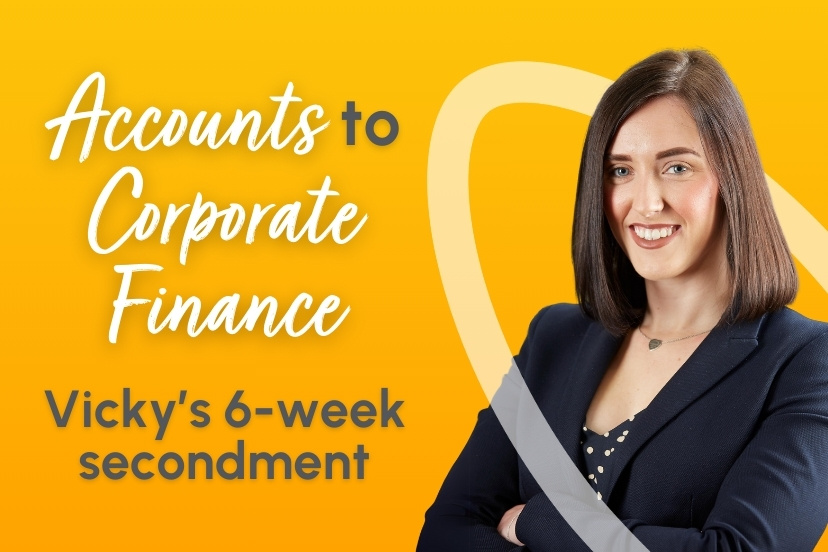
DTE recently welcomed Vicky Harvey, a Senior Accountant based at our Stoke office, to their Corporate Finance team on secondment.
Vicky’s role at DJH sees her completing single entity accounts to group consolidated accounts, company corporation tax returns, self-assessment tax returns and assisting with training DJH’s AAT trainees.
However, Vicky had also been involved with some due diligence reports and found them interesting to work on, therefore she wanted to gain more experience with them to help aid her career progression. It was the perfect timing as DTE were also looking for someone to support them on some upcoming work!
We sat down with Vicky to get an insight into her experience at DTE Corporate Finance:
Can you give us a sense of the type of work you were involved in?
The team had me involved in many different projects and kept it varied which was great. I was involved in creating a business plan, creating an information memorandum (IM), researching for buyers and investors, creating company fact files to aid in pitches, populating data rooms as well as analysis of financial information.
What skills do you think are most important to succeed in Corporate Finance and why?
I think it is valuable to have knowledge of accounting, reporting, regulations and taxation. When creating reports, these are the areas that are focused on, and you will need to be able to confidently comment on your findings.
Other skills that I think are important to succeed are:
- Time management and ability to multitask – every day working in Corporate Finance can be different and you can have several tasks or projects on the go at once.
- Business knowledge – you need to understand various business sectors and the way in which they operate.
- Interpersonal skills – in Corporate Finance you communicate with a lot of people, including your own team, other departments in the business, and investors, clients, bankers, and solicitors.
What have you enjoyed the most about your time in Corporate Finance?
I can’t pin it down to only one, but the top three things I enjoyed were:
- Having exposure to various new tasks that I haven’t previously completed, which meant gaining valuable experience that I’ve since been able to use in my work.
- Meeting and working with new colleagues within the group.
- Attending Corporate Finance specific events with the team, such as the mergers and acquisitions breakfast. The event detailed the full acquisition process and I felt as though this consolidated my knowledge of why I was doing a task and the order it was completed in.
How did you find working with the Corporate Finance team?
The team were very welcoming. Whenever I had any questions, I felt comfortable approaching any member within the team, and they would take the time to go through my queries in detail.
When they reviewed my work, they would always comment on what I had done well and give me suggestions on what I could also include, based upon their knowledge and experience.
They really made an effort to make me feel part of their team and included me in meetings (both internal and external), events and team socials.